

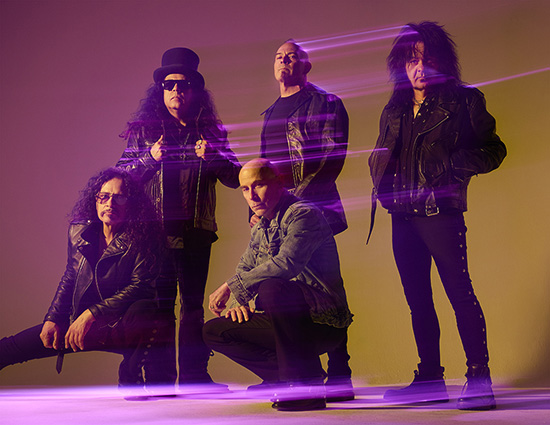
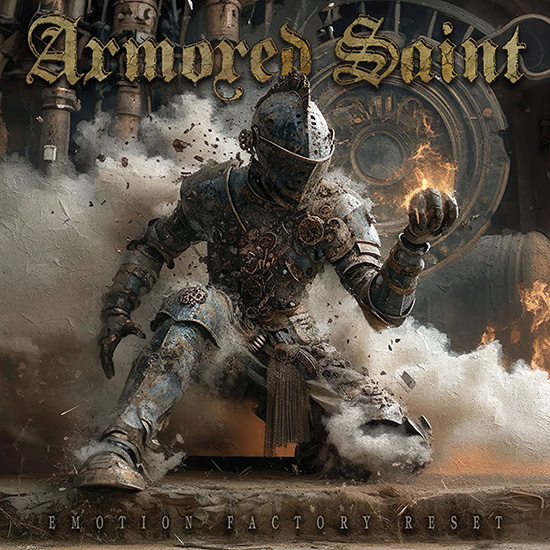
More than four decades after their formation, Armored Saint still refuse to follow the rules. With the release of “Emotion Factory Reset”, the Los Angeles veterans continue to challenge both themselves and their audience while remaining true to the identity that has made them one of American heavy metal’s most respected names. In this conversation, guitarist and songwriter Joey Vera discusses why creative freedom will always matter more than expectations, how “Symbol of Salvation” changed the band’s trajectory forever, and why the spirit of the New Wave of British Heavy Metal still runs through Armored Saint’s veins.
I believe, Joey, that we spoke when you released the last album.
– That was a while ago.
Yeah, it is. Six years ago. Would you label “Punching the Sky” as a successful album in the history of Armored Saint?
– Yeah, sure, I do. It got a lot of really good reviews. A lot of people liked it. We did a lot of videos for it, and a bunch of touring as well. So yeah, I think it was a really good success.
A few of the members of Armored Saint have said that you never repeat yourselves when it comes to releasing a new album. What distinguishes this new one from the last one, in your opinion?
– Well, we try not to repeat ourselves. I’m not sure we completely succeed in doing that, but in terms of the songwriting, we try. The production team we’ve been using since “Win Hands Down” is basically the same. There’s a lineage there that hasn’t changed too much. I’m still acting as producer, and every record since “Win Hands Down” has been mixed by Jay Ruston. Bill Metoyer has worked with us on all those records, particularly on the guitar sounds. The main differences this time are in the details. The drums were recorded at Dave Grohl’s Foo Fighters studio in Los Angeles, and we worked with engineer Oliver Roman, who’s a great guy and a great engineer. That gave the drums a slightly different character. Gonzo also has a brand-new drum kit, which affects the sound. More importantly, I think we approach every record with a slightly different intention. As a result, the songs become somewhat unique, and the collection of songs has its own identity. If I had to explain why our records differ from one another, it would basically be that.
This is your ninth album. Are you still excited when there’s a new Armored Saint album coming? Do you still care about how it is received by the public and music journalists, or is that more or less irrelevant for you?
– To be honest, we really do this for ourselves first. That might sound selfish, but it’s important for us to feel connected to what we’re trying to say and write at any given time. Maybe that’s why it takes us a long time to make records. We put one out every five or six years, and some people think that’s a long time. But we have to be genuinely motivated and inspired to make an album. So yes, we do this for ourselves first. That said, I’d be lying if I said we didn’t care what other people think. We absolutely want a connection with our fans, and we want that dialogue to continue, just as it has for more than forty years. At the same time, we want to challenge our listeners, our fans, and even the press a little bit.I’m not going to make a record that completely alienates the fanbase or ignores what people appreciate about Armored Saint. But I also don’t want to bend over backwards trying to satisfy imagined expectations. We have to take a somewhat selfish position and say, “This is what we’re doing. We hope you dig it.” If people don’t like it, then so be it.
It’s been 43 years since the first EP was released. I guess I don’t have to ask whether you expected back then that the band would last this long, but when did you realize that Armored Saint would become a very long-running band?
– I don’t know if there was a specific moment. Maybe the first glimpse of that came when we got back together after John joined Anthrax and the band had been largely inactive throughout the 1990s. When we reunited to make “Revelation”, the response was really positive. You have to remember that around 1999 and 2000, the internet and social media were still in their formative years. MySpace existed, but things weren’t as connected as they are today. It was difficult to gauge whether people still cared about the band. The only clues we had came from touring. I was playing with Fates Warning and John was touring with Anthrax. Everywhere we went, people kept asking about Armored Saint and telling us we needed to get back together. At the end of the nineties, John and I started having conversations about that. People still cared. The band was around twenty years old at that point, so maybe that was when we first realized there was still an audience that wanted to hear new music from us.
I remember reviewing “Revelation” for Scream Magazine when it came out 26 years ago. But then there was such a long gap before the next album. Why was that?
– It was actually about ten years. “Revelation” came out around 2000, and then we didn’t release another proper studio album until “La Raza” in 2010. John was still in Anthrax until 2006, and I was busy with Fates Warning. We both had plenty going on. During that period, Armored Saint was, for lack of a better term, a side project. It wasn’t John’s priority and it wasn’t mine. We did a bit of touring in the early 2000s, but not much else. Around 2008 or 2009, we decided it was time to start writing together again, and that eventually became “La Raza”.
How do you view the “Revelation” album today? Is it one of your better albums?
– To be honest, I think there are some really cool moments on it, but it’s a bit of a mix-and-match record. Some of the songs originated during the early nineties around the “Symbol of Salvation” era. Tracks like “Dead of Winter” and “Upon My Departure” came from unfinished ideas we had back then. Other songs, like “Tension” and “Control Issues,” were completely new. So it’s a combination of old and new material. I think it misses the mark in a few places, but there are some really strong moments. The production reflects the fact that it was the first full album I produced by myself. Sometimes I listen back and think, “Why did I let that pass?” But overall, I think it was the beginning of something that would evolve into something much stronger later. It was an important stepping stone.
Let’s turn the attention back to the new one. “Emotion Factory Reset” is a line from the song “Close to the Bone.” How is that title relevant to the album as a whole?
– We were all involved in choosing the album title. Everybody pulled lines from John’s lyrics, and we ended up with a long list. “Emotion Factory Reset” was a phrase that Phil Sandoval contributed during the writing process, and John used it in “Close to the Bone.” I liked it because it suggested the idea of rebuilding. When you reset something, you wipe away the data and return it to its original state. From there, you can rebuild it into something new. That resonated with me because I’ve always viewed our albums as snapshots of where we are emotionally and creatively at a particular point in time. Each record feels like a new skin. So the idea of a reset worked perfectly. It fit the spirit of what a new Armored Saint album represents.
The song titles on your recent albums are refreshingly non-heavy-metal, if you know what I mean. The old clichés from albums like “March of the Saint” and “Raising Fear” are largely gone. Is that part of growing older and wiser?
– That’s probably more a question for John, but I think he would say that he’s always trying to do something different and unexpected. He doesn’t want to follow the rules, whether we’re talking about heavy metal or any other genre. He’s always looking for titles, concepts, and ideas that stand out. Sometimes he comes up with phrases that are perhaps a little too unusual, and then we discuss whether there’s a clearer or more memorable way to express the same idea. We never really argue about it, but we do talk things through. More broadly, we simply don’t want to live inside anyone else’s expectations. That applies to both the music and the lyrics. We don’t feel the need to fit inside a particular box.
No, I think it’s a really good thing. You can still hear that it’s Armored Saint, but it doesn’t sound dated. It sounds updated. I actually think you’re one of the bands that has managed that better than most.
– Thank you. We definitely work hard at that. It’s not easy. Part of me always wants to stay connected to where we came from because I don’t want to completely alienate people. At the same time, I also want to introduce things that are unexpected. John and I love R&B, classic pop from the sixties and seventies, and all kinds of other music. I’m influenced by early Judas Priest and Motörhead, but also by bands such as Foo Fighters, Queens of the Stone Age, Mastodon, and Ghost. I listen to jazz as well, and I’m constantly pulling ideas from different places. Maybe that’s part of why the music feels more modern. There’s a little bit of everything in there.
Is that important for you when choosing the bands you’re involved with? Because I think Fates Warning has a similar philosophy. Jim Matheos has never wanted the band to stand still either. It keeps evolving and incorporating new influences. Is that an important mindset for you?
– Sure, absolutely. Speaking of Fates Warning, I think that band had a huge impact on me, both as a songwriter and as a musician. I learned a great deal from working with Jim Matheos, Ray Alder and the rest of the guys. I took many things away from that experience. Sometimes I’ll subtly incorporate odd time signatures, and a lot of that influence comes directly from Fates Warning. More importantly, the band inspired me to take chances, to be daring, and to step outside my comfort zone. I might not have developed that mindset to the same extent if I hadn’t spent those years with them. So I definitely credit Jim, Ray and Fates Warning for helping me find that confidence.
I see. I was reading the press release I got from Metal Blade. You’re quoted there saying that you try not to overthink when composing music. What does overthinking look like for you?
– In the case of a band like ours, which has been around for more than four decades, overthinking often means trying too hard to please the fan base. If that becomes your primary concern, I think you’re making a mistake. I’m more willing to risk losing a few fans by challenging them with new music, new ideas, or something unexpected. At the same time, I don’t want to go too far in the opposite direction and create something so complicated, alienating, or esoteric that people can’t connect with it. That would be overthinking as well. When I start writing, I always keep in mind what we’ve done in the past. Then I ask myself how I can bring in fresh influences and make things feel more contemporary. That’s my starting point. Once John Bush and I begin sharing ideas and getting excited about the material, we simply let it develop naturally. We don’t sit there saying, “The next song should be fast,” or “The next one should be funky.” There’s none of that. Once we get a couple of demos together and feel that momentum, everything becomes very liberating. The door opens and you just walk through it to see where it leads. Of course, we wrote around fourteen songs for this album and some of them didn’t make the cut. In a few cases we realized we were forcing things too much or overthinking them. So we put those aside and concentrated on the ten or eleven songs that felt right. That’s really what not overthinking means. You get to a place where things are flowing naturally, and then you trust that process.
A couple of weeks ago I was in Oslo and saw the 35th-anniversary edition of Symbol of Salvation in some record stores. I bought that album when it came out. I like all Armored Saint albums, but I think that one is world class. Is it your favorite Armored Saint album too?
– I don’t know if I can say it’s my favorite. Right now, the new album is my favorite, but of course I’m going to say that. What I will say is that “Symbol of Salvation” has a very special place in my heart, and there are a couple of reasons for that. The first reason is that it was an incredibly difficult album to finish. As most people know, we lost our friend and founding member Dave Pritchard to leukemia during that period. We had been writing music together, and then Dave became ill. Watching him go through that and eventually pass away was devastating. At the same time, we’d been dropped by Chrysalis Records and no longer had a record deal. We spent five years writing material during that period and ended up with something like twenty-four songs. It was an incredibly challenging time for us. The fact that we eventually regrouped after Dave’s passing, brought Jeff Duncan into the band, welcomed Phil Sandoval back, and completed “Symbol of Salvation” felt like a triumph. We’re proud of that record for that reason alone. The songs were great, the production with Dave Jerden was fantastic, and most of the material had been written alongside Dave. There was so much blood, sweat and tears invested in that album. The second reason is that it marked a turning point creatively. During the years without a record label, we started thinking outside the traditional heavy metal framework. For the first time we stopped worrying so much about fitting in and began taking chances. To me, “Raising Fear” is a record where we were overthinking things. We were trying too hard to fit expectations. A lot of people love that album and there are great moments on it, but that’s how I hear it. “Symbol of Salvation” was the opposite. It was a band that felt free. It was a band willing to take risks and push boundaries. That album was the first time we really established our own identity. From that point onward, every Armored Saint album has occupied its own little island. Each one is a little different from the previous record. Symbol of Salvation was the first step down that path, and eventually that path leads all the way to “Emotion Factory Reset”. So that’s my two cents on why “Symbol of Salvation” remains such an important album.
You mentioned the New Wave of British Heavy Metal as one of your major influences. How important was that movement for Armored Saint, and what were your own favorites from that era?
– It was hugely important because we were right there when it happened. We were teenagers around 1980 and 1981, and although the movement technically began a little earlier, by then it was in full swing. Before that we were already listening to Judas Priest, Scorpions, UFO, Thin Lizzy, Black Sabbath, Queen, Cheap Trick, Aerosmith and bands like that. So when the New Wave of British Heavy Metal exploded, it felt like a natural extension of everything we already loved. The impact of albums like “Ace of Spades”, Iron Maiden’s debut, “Killers”, Def Leppard’s “On Through the Night”, Saxon’s “Denim and Leather” and “Wheels of Steel” was enormous. Thin Lizzy’s “Thunder and Lightning” was another big one. Then I started getting into more obscure bands like Jaguar, Diamond Head, Mercyful Fate and even groups like H-Bomb from France. It really felt like we were part of a community. Heavy metal wasn’t mainstream yet. We were all discovering these bands together, and because of our age and where we were in our own development as musicians, we got swept up in that movement. It had a massive influence on our trajectory and the way we write music. Even today, songs like “Close to the Bone” are about as close to the New Wave of British Heavy Metal as I can get. I freely admit that. It’s something I’ll always pay tribute to in one way or another.
Really cool. You’ve performed with a huge number of musicians over the years. Is there someone you haven’t worked with yet that you’d love to collaborate with?
– That’s a good question. I’ve admired the work of Mikael Åkerfeldt from Opeth for many years. I think he’s incredibly talented, creative, and into a lot of the same music that I am. I would love to work with him. Tobias Forge from Ghost is another one. I’ve met him a few times and he’s a genuinely down-to-earth guy. I love his sense of melody and harmony, and I think we share a lot of musical sensibilities. I’d also love to work with Dave Grohl. We mentioned Foo Fighters earlier. Dave seems like an incredibly creative person, someone who’s always full of ideas and would simply be a lot of fun to work with. Those are probably the first names that come to mind.
Last question for you, Joey. You’re playing a number of shows and festivals this summer with bands like Metal Church, Savatage, Testament and possibly Crimson Glory. These are bands from more or less the same era. It sounds like a great atmosphere, but I suppose there’s not always that much time to hang out and watch each other perform.
– Testament as well. I’ve actually become much closer to Chuck Billy in the last year or two, so it’s going to be great doing shows with them. We’ve toured with Metal Church before in Europe. Kurdt Vanderhoof has always been a big supporter of Armored Saint, and I’ve always loved his work. He’s a tremendous riff writer. I’ve known Chris Caffery from Savatage for a long time too. Fates Warning played shows with Savatage years ago, and I’ve spent plenty of time with Chris since then. He’s a great guy, and the rest of the band are fantastic as well. Hopefully we’ll have some time to hang out and watch each other’s sets. I definitely plan on watching Savatage, Testament, Metal Church and Crimson Glory whenever possible. I always try to catch the bands we’re touring with. I think it’s a really cool thing. We all came up around the same time and it’s great to still be doing shows together after all these years. I think the fans appreciate that as well.

